News January 2026
Tri-State’s International Conference grant awardees announced
And the winners are…
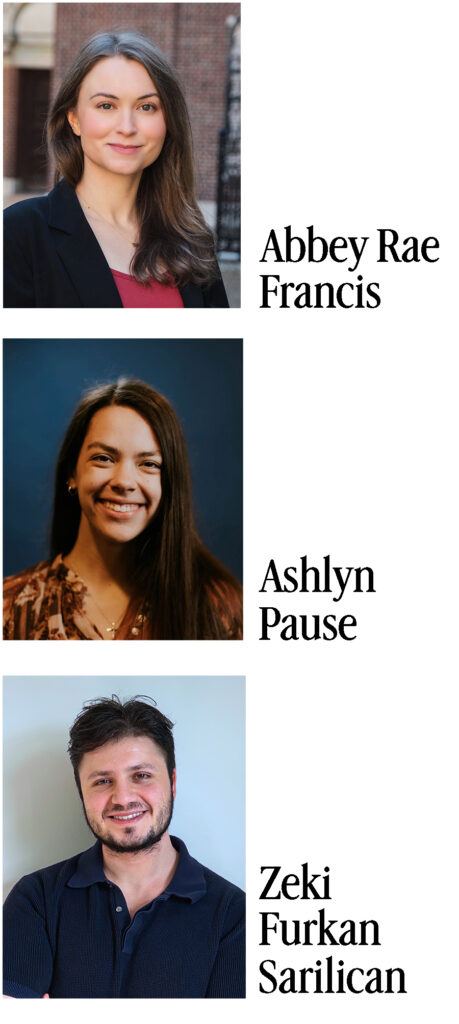
DOCOMOMO US/New York Tri-State is pleased to announce three awardees of its student and emerging professional grants to support participation in the 19th International Docomomo Conference being held March 17-22 in Los Angeles. Each will receive $1,200 to cover expenses associated with attending the conference. Attendees can anticipate a dynamic program featuring exciting venues, scholarly sessions, vibrant networking and social events, and the signature Docomomo tours. After the conference the grant recipients will submit a brief article on their experience which will be published on the DOCOMOMO US/NY Tri-State website.
Abbey Rae Francis is a Master of Science candidate in the Historic Preservation program at Columbia University’s GSAPP. After earning her B.A. in History and Anthropology from Wesleyan University, she worked for several years in her hometown of San Antonio, TX as a researcher and project manager. She is writing a thesis tentatively titled Textiles: Addressing Ephemeral Materials in the Preservation of Modern Architecture, arguing that textiles in modern buildings often function as key elements of a space’s architectural design and character. She hopes to create a roadmap for practitioners to manage “architectural textiles” as the discipline increasingly turns toward the preservation of Modern architecture.
Ashlyn Pause is a second-year graduate student in Historic Preservation at Columbia University’s Graduate School of Architecture Preservation and Planning. Her research focuses on the significance of high-pressure laminates (HPL) in Modern American architecture, how compositional changes in laminates have impacted its survival in residential spaces, and strategies for the material’s preservation in the face of current demolition trends.
Zeki Furkan Sarilican is a third year PhD student and a Rutgers Presidential Fellow. His current research focuses on the transnational circulation of the Modern Movement, with particular attention to how American architectural ideals were translated and institutionalized outside the US during the 20th century. He is examining the role of SOM as a key agent in this process, both domestically and internationally, where the firm’s campus planning and International Style vocabulary shaped educational architecture across geopolitical contexts. Prior to his doctoral studies, Furkan earned his master’s degree from Middle East Technical University’s Architectural History Department with his thesis titled “Robert College: The Building of an American School in Istanbul, 1863-1977.”
More about the conference
The biennial International Docomomo Conference is headed stateside for only the second time since the organization’s founding, convening a global community of members and colleagues to engage deeply with pressing international issues and emerging ideas shaping the future of the built environment through the lens of the Modern Movement. Attendees can anticipate a dynamic program featuring exciting venues, scholarly sessions, vibrant networking and social events, and the signature Docomomo tours. Formal conference proceedings will also be published.
19th International Docomomo Conference
Los Angeles, California
Multiple Moderns: Climate, Community, Creativity
March 17 – 22, 2026
The Conference invites a rich exploration of the pluralistic character of the twentieth-century global modern movement and its varied legacies, emphasizing how climate, community, and creativity have shaped—and continue to shape—the built environment. Drawing inspiration from Los Angeles, a city emblematic of multiple moderns, it encourages examination of diverse modern places and urban forms, spanning pre- and post-World War II traditions through the century’s end. It celebrates the enduring spirit of innovation behind architectural currents such as late modernism, postmodernism, and deconstructivism, while also recognizing the everyday modern architecture embedded in communities worldwide. The discussion will consider sprawling, automobile-oriented urban growth in contrast to compact city models and will critically engage with modern buildings and landscapes in the context of climate crisis, highlighting adaptation strategies and disaster resilience. Central to this inquiry is how diverse communities have shaped, inhabited, and continue to transform modern environments to meet evolving needs and aspirations.
Visit the conference webpage